
Tag Archives: cosmological constant

2011 Nobel Prize for Dark Energy Discovery

Measurements of Dark Energy and Matter content of Universe

Dark Energy and Matter content of Universe: The intersection of the supernova (SNe), cosmic microwave background (CMB) and baryon acoustic oscillation (BAO) ellipses indicate a topologically flat universe composed 74% of dark energy (y-axis) and 26% of dark matter plus normal matter (x-axis).

The 2011 Nobel Prize in Physics, the most prestigious award given in the physics field, was announced on October 4. The winners are astronomers and astrophysicists who produced the first clear evidence of an accelerating universe. Not only is our universe as a whole expanding rapidly, it is in fact speeding up! It is not often that astronomers win the Nobel Prize since there is not a separate award for their discipline. The discovery of the acceleration in the universe’s expansion was made more or less simultaneously by two competing teams of astronomers at the end of the 20th century, in 1998, so the leaders of both teams share this Nobel Prize.

The new Nobel laureates, Drs. Saul Perlmutter, Adam Riess, and Brian Schmidt, were the leaders of the two  teams studying distant supernovae, in remote galaxies, as cosmological indicators. Cosmology is the study of the properties of the universe on the largest scales of space and time. Supernovae are exploding stars at the ends of their lives. They only occur about once each fifty to one hundred years or so in a given galaxy, thus one must study a very large number of galaxies in an automated fashion to find a sufficient number to be useful. The two teams introduced new automated search techniques to find enough supernovae and achieve their results.

During a supernova explosion, driven by rapid nuclear fusion of heavy elements, the supernova can temporarily become as bright as the entire galaxy in which it resides. The astrophysicists studied a particular type of supernova known as Type Ia. These are due to white dwarf stellar remnants exceeding a critical mass. Typically these white dwarfs would be found in binary stellar systems with another, more normal, star as a companion. If a white dwarf grabs enough material from the companion via gravitational tidal effects, that matter can “push it over the edge” and cause it to go supernova. Since all occurrences of this type of supernova event have the same mass for the exploding star (about 1.4 times the Sun’s mass), the resultant supernova has a consistent brightness or luminosity from one event to the next.

This makes them very useful as so-called standard candles. We know the absolute brightness, which we can calibrate for this class of supernova, and thus we can calculate the distance (called the luminosity distance) by comparing the observed brightness to the absolute. An alternative measure of the distance can be obtained by measuring the redshift of the companion galaxy. The redshift is due to the overall expansion of the universe, and thus the light from galaxies when it reaches us is stretched out to longer, or “redder” wavelengths. The amount of the shift provides what we call the redshift distance.

Comparing these two different distance techniques provides a cosmological test of the overall properties of the universe: the expansion rate, the shape or topology, and whether the expansion is slowing down, as was expected, or not. The big surprise is that the expansion from the original Big Bang has stopped slowing down due to gravity and has instead been accelerating in recent years! The Nobel winners did not expect such a result, thought they had made errors in their analyses and checked and rechecked. The acceleration did not go away. And when they compared the results between the two teams, they realized they had confirmed each others’ profound discovery of the reality of a dark energy driven acceleration.

The acceleration result is now well founded since it can be seen in the high spatial resolution measurements of the cosmic microwave background radiation as well. This is the radiation left over from the Big Bang event associated with the origin of our universe.

The acceleration is now increasingly important, dominating during the past 5 billion years of the 14 billion year history of the universe. Coincidentally, this is about how long our Earth and Sun have been in existence. The acceleration has to overcome the self-gravitational attraction of all the matter of the universe upon itself, and is believed to be due to a nonzero energy field known as dark energy that pervades all of space. As the universe expands to create more volume, more dark energy is also created! Empty space is not empty, due to the underlying quantum physics realities. The details, and why dark energy has the observed strength, are not yet understood.

Amazingly, Einstein had added a cosmological constant term, which acts as a dark energy, to his equations of General Relativity even before the Big Bang itself was discovered. But he later dropped the term and called it his worst blunder, after the expansion of the universe was first demonstrated by Edwin Hubble over 80 years ago. It turns out Einstein was in fact right; his simple term explains the observed data and the Perlmutter, Riess, and Schmidt measurements indicate that ¾ of the mass-energy content of the universe is found in dark energy, with only ¼ in matter.

Our universe is slated to expand in an exponential fashion for trillions of years and more, unless some other physics that we don’t yet understand kicks in. This is rather like the ever-increasing pace of modern technology and modern life and the continuing inflation of prices.

We honor the achievements of Drs. Perlmutter, Riess, and Schmidt and of their research teams in increasing our understanding of our universe and its underlying physics. Interestingly, only a few weeks ago, a very important supernova in the nearby M101 galaxy was discovered, and it is also a Type 1a. Because it is so close, only 25 million light years away, it is yielding a lot of high quality data. Perhaps this celestial fireworks display was a harbinger of their Nobel Prize?

References:

http://www.nytimes.com/aponline/2011/10/04/science/AP-EU-SCI-Nobel-Physics.html?_r=2&hp

http://www.nobelprize.org/nobel_prizes/physics/laureates/2011/press.html

http://www.nobelprize.org/mediaplayer/index.php?id=1633 (Telephone interview with Adam Reiss)

http://supernova.lbl.gov/ (Supernova Cosmology Project)

https://darkmatterdarkenergy.wordpress.com/2011/08/31/m101-supernova-and-the-cosmic-distance-ladder/

https://darkmatterdarkenergy.wordpress.com/2011/07/04/dark-energy-drives-a-runaway-universe/


M101 Supernova and the Cosmic Distance Ladder

Last week, on August 24, there was a very fortuitous and major discovery by UC Berkeley and Lawrence Berkeley National Lab astronomers of a nearby Type 1a supernova, named PTF 11kly, in the nearby Pinwheel Galaxy. This galaxy in Ursa Major is also known as M101 (the 101st member of the Messier catalog). Type 1a supernovae are key to measuring the cosmological distance scale since they act as “standard candles”, that is, they all have more or less the same absolute brightness. Dark energy was first discovered through Type 1a supernovae measurements. These supernovae are due to certain white dwarf runaway thermonuclear explosions.

Supernova in M101

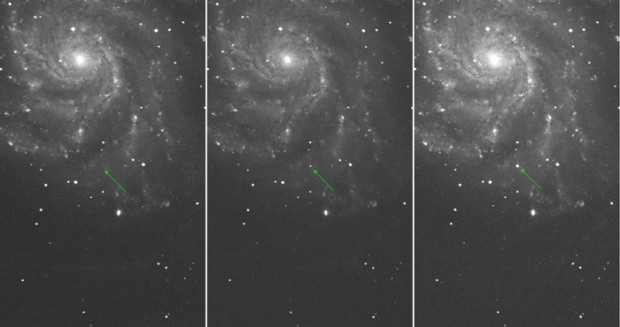
Supernova in M101 (Credit: Lawrence Berkeley National Laboratory, Palomar Transient Factory team)

Three photos on 3 successive nights, with the supernova not detectable on 22 August (left image), detectable (pointed to by green arrow) on 23 August (middle image) and brighter on 24 August (right image).

A white dwarf is the evolutionary end state for most stars, including our Sun eventually, after it exhausts the hydrogen and helium in its core via thermonuclear fusion. Some of the star’s outer envelope is ejected during a nova phase but the remaining portion of the star collapses dramatically, until it is only about the size of the Earth. This is due to the lack of pressure support that previously was generated by nuclear fusion at high temperatures. This is not a supernova event; it is the prior phase that forms the white dwarf. The white dwarf core is usually composed primarily of carbon and oxygen. The collapse of the core is halted by electron degeneracy pressure. The electron degenerate matter, of which a white dwarf is composed, has its pressure determined by quantum rules that require that no two electrons can occupy the same state of position and momentum.

A Type 1a supernova is formed when a white dwarf of a particular mass undergoes a supernova explosion. It was shown in the 1930s by Chandrasekhar that the maximum mass supportable in the white dwarf state is 1.38 solar masses (1.38 times our Sun’s mass). In essence, at this limit, the electrons are pushed as close together as possible. If the white dwarf is near this limit and sufficient mass is added to the white dwarf, it will ignite thermonuclear burning of carbon and oxygen nuclei during a very rapid interval of a few seconds and explode as a supernova. The explosion is catastrophic, with all or nearly all of the star’s matter being thrown out into space. The supernova at maximum is very bright, for a while perhaps as bright as an entire galaxy. The additional mass that triggers the supernova is typically supplied by tidal accretion from a companion star found in a binary system with the white dwarf.

Because they all explode with the same mass, Type 1a supernovae all have more or less the same absolute brightness. This is key to their usefulness as standard candles.

In 1998 two teams of astronomers used these Type 1a supernovae to make the most significant observational discovery in cosmology since the detection of the cosmic microwave background radiation over 30 years earlier. They searched for these standard candle supernovae in very distant galaxies in order to measure the evolution and topology of the universe. Both teams determined the need for a non-zero cosmological constant, or dark energy term, in the equations of general relativity and with their initial results and others gathered later, its strength is seen to be nearly 3/4 of the total mass-energy density of the universe. These results have been confirmed by other techniques, including via detailed studies of the cosmic microwave background.

One needs two measurements for each galaxy to perform this test: a measurement of the redshift distance and a measure of the luminosity distance. The redshift distance is determined by the amount of shift toward the red portion of major identifier lines in the host galaxy’s spectrum, due to the expansion of the universe (the host galaxy is the galaxy in which a given supernova is contained.) The apparent brightness of the supernova relative to its absolute brightness provides the luminosity distance. Basically the two teams found that the distant galaxies were further away than expected, implying a greater rate of continuing expansion – indeed an acceleration – of the universe during the past several billion years compared to what would occur without dark energy.

What is exciting about the M101 supernova discovery last week is that it is so nearby, so easy to measure, and was caught very soon after the initial explosion. By studying how bright it is each day as the supernova explosion progresses, first brightening and then fading (this is known as the light curve), it can help us tie down more tightly the determination of the distance. This in turn helps to provide further precision and confidence around the measurement of the strength of dark energy.

References:

http://www.dailycal.org/2011/08/28/uc-berkeley-researchers-find-brightest-closest-supernova-in-years/

http://arxiv.org/abs/astro-ph/9812133  Perlmutter et al. 1999 “Measurements of Omega and Lambda from 42 High-Redshift Supernovae” Astrophys.J.517:565-586

 http://arxiv.org/abs/astro-ph/9805201  Reiss et al. 1998 “Observational Evidence from Supernovae for an Accelerating Universe and a Cosmological Constant” Astron.J.116:1009-1038

http://en.wikipedia.org/wiki/White_dwarf

http://en.wikipedia.org/wiki/Type_1a_supernova

http://en.wikipedia.org/wiki/Cosmic_distance_ladder


Dark Energy Drives Runaway Universe

Accelerating universe

Accelerating universe graphic. Credit: NASA/STSci/Ann Field

Dark energy was first introduced as a possibility as a result of the formulation of Einstein’s equations of general relativity. When he considered how the universe as a whole would behave under the general relativity description of gravity, he added a term to his equations, known as the cosmological constant. At the time the prevailing view was that the universe was static, and neither expanding nor contracting. The term was intended to balance the self-gravitational energy of the universe, and it thus acts as a repulsive force, rather than an attractive one. His basis for introduction of the cosmological constant was erroneous in two respects. The first problem is that the static solution was unstable, as if balanced on a knife edge. If you nudged it a little bit by increasing the matter density in some region slightly, that region would collapse, or if you lowered the density ever so slightly, that region would expand indefinitely. The second problem is that by 1929 Edwin Hubble had demonstrated the universe is actually expanding at a significant rate overall.

Subsequently, Einstein called the introduction of the cosmological constant his “greatest blunder”. After the realization that we live in an expanding universe, while the possibility of the cosmological constant having a non-zero value was sometimes entertained in cosmological theory, it was mostly ignored (set to zero). Over the next several decades, attention turned to better measuring the expansion rate of the universe and the inventory of matter, both ordinary matter and the dark matter, with the amount of the latter implied by long range gravitational effects seen both within galaxies and between galaxies. Was there enough matter of both types to halt the expansion? It seemed not, rather that there was only about 1/4 of the required density of matter, and that was mostly in the form of dark, not ordinary matter. Matter of either type would slow down the expansion of the universe due to its gravitational effects.

After 1980, the inflationary version of the Big Bang gained acceptance due to its ability to explain the flat topology of the universe and the homogeneity of the cosmic microwave background radiation, the relic light from the Big Bang itself. The inflationary model strongly indicated that the total energy density should be about 4 times greater than seen from the matter components alone. It is the total of energy and matter (the energy content of matter) which determines the universe’s fate, since E = mc^2.

In 1998 the astounding discovery was made that the universe’s expansion rate is accelerating! This was determined by two different teams, each of which were making measurements of distant supernovae (exploding stars). And it was confirmed by measurements of tiny fluctuations in the intensity of the microwave background radiation. The two techniques are consistent, and a third technique based on X-ray emission from clusters of galaxies, as well as a fourth technique based on very large scale measurements of relative galaxy positions, also give results consistent with the previous two techniques. The inflationary predictions are satisfied with dark energy presently three times more dominant than the rest mass energy equivalent from dark matter plus ordinary matter. Further measurements have refined our understanding of the relative strength of dark energy in comparison to dark matter and ordinary matter. The best estimates are that, today, dark energy is 74% of the universe’s total mass-energy balance.

In the cosmological constant formulation, dark energy is constant in time, while the matter density drops as the universe expands, in proportion to the cube of the scale factor. So if we consider the universe in its early days the energy contained in the dark matter would have dominated over dark energy, as the mass density would have been much greater than today. The crossover from matter dominated to dark energy dominated came after the universe was about 9 billion years old, or about 5 billion years ago. This emergence of dark energy as the dominant force, due to its nature as a repulsive property of “empty” space-time, results in an accelerating expansion of the universe, which has been called the “runaway universe”. Our universe is apparently slated to become hugely larger than its current enormous size.

Why is dark energy important then? Since five billion years ago, and on into the indefinite future, it has dominated the mass-energy content of the universe. It drives a re-acceleration of the universe. It inhibits the re-collapse (“Big Crunch”) of our entire universe or even substantial portions of the universe. Thus it naturally extends the life of the entire universe to trillions of years or much more – far beyond what would occur were the universe to be dominated by matter only and with density at the critical value or above. Dark energy thus works to maximize the available time and space for life to develop and to evolve on planets found throughout the universe.