Tag Archives: Dark matter

Why the Higgs Boson is not Dark Matter

The Higgs boson is considered a necessary part of the Standard Model of particle physics. In the Standard Model there are 3 main forces of nature: the electromagnetic force, the weak nuclear force, and the strong nuclear force. The Standard Model does not address gravity and we do not yet have a proven theory for the unification of gravity with the other 3 forces.

On July 4th CERN, the European particle physics lab near Geneva, announced that two experiments using the Large Hadron Collider accelerator, ATLAS and CMS, have both amassed strong statistical evidence (around 5 sigma) for a new particle. This new particle has a mass of about 126 GeV* and “smells” very much like it is the long sought after, and elusive, Higgs boson. The prediction of the Higgs dates from 1964. For comparison, the proton mass is about 0.94 GeV, so the Higgs is around 134 times more massive. Further work is necessary to determine all of its properties, but at this point it looks as if the new particle decays into other particles in the expected manner. It is these decay products that are actually detected.

This decades-long search has proceeded in fits and starts, principally at CERN in Europe and Fermilab in the U.S., with different accelerators and detectors. Over time the experiments were able to exclude possible masses for the Higgs, since the rate of creation of different decay products varies for different putative masses. By the end of 2011 it looked like there was a preliminary signal, not yet of sufficient statistical strength, but that the mass would have to be in the range of about 115 to 130 GeV.

Image

The CMS detector at the Large Hadron Collider. Credit: Mark Thiessen/National Geographic Society/Corbis

One of my professors, Steven Weinberg, won the Nobel Prize in Physics years ago for his work on unifying the electromagnetic force and the weak force. While the Standard Model and the body of work in particle physics provides a theoretical underpinning for all of the particles which we observe, and their quantum properties, and describes a unification of the strong force (which holds together the quarks inside a proton or neutron) with these other two forces, it also requires an additional mechanism to explain why most particles have non-zero masses.

The Higgs mechanism is the favored explanation, and it predicts a particle as the mediator to provide masses to other particles. The Higgs mechanism is theorized as an all-pervasive Higgs field, which slows down particles as they move through it. As you swim through water you feel a drag that slows you down. A fish with a very hydrodynamic design will feel less drag. In the particle world, more massive ones slow down more than the lighter ones, since they interact more strongly with the Higgs field.

The particle corresponding to this mechanism is known as the Higgs boson. Particles can have quantum spin that is a multiple of ½ or an integer multiple. Bosons have integer multiple spins. Actually the spin of the Higgs boson is zero. All of the force mediator particles such as the photon (spin = 1), which mediates electromagnetism, are bosons.

The Large Hadron Collider is in some sense recreating the conditions of the very early universe by smashing particles together at 7000 GeV, or 7 TeV. The Higgs originally would have been created in Nature in the very early part of the Big Bang, around the first one-trillionth of a second. The appearance of the Higgs broke the unification, or symmetry, between the electromagnetic and weak forces that Steven Weinberg demonstrated are one at very high energies. And the Higgs gave mass to particles.

Without the Higgs mechanism, all particles would be massless, and thus travelling at the speed of light, and structure in the universe – stars, planets, galaxies, human beings, would not be possible. Even the existence of the proton itself requires that quarks have mass, although most of the proton mass comes from the energy of the gluons (strong force mediation particle) and ‘virtual’ quark-antiquark pairs found inside it.

The Higgs boson cannot be the explanation for dark matter for a very simple reason. Dark matter must be stable with a very long lifetime, persisting over the universe’s present age of 14 billion years. It mostly sits in space doing nothing except providing additional gravitational interaction with ordinary matter. The favored candidate for dark matter is the least massive supersymmetric particle; being the least massive, it would have nothing to decay into. Supersymmetry is a theoretical extension beyond the Standard Model. No supersymmetric particles are detected as of yet, but the theory has a lot of support and has the benefit of stabilizing the mass of the Higgs itself.

The Higgs boson, on the other hand, decays very rapidly. There are various decay channels, including into quarks, W/Z bosons, leptons or photons, producing these in pairs (two Zs, two top quarks etc.). Sometimes even four particles are produced from a single Higgs decay. It is these decay products that are actually detected in the Large Hadron Collider at CERN.

There are a few experiments that are claiming to have directly detected dark matter. The favored mass range from the COGENT and DAMA/LIBRA experiments is around 10 GeV for dark matter, much more than a proton, but less than 10% of the Higgs’ mass. Now that the Higgs appears to have been found, work will proceed on confirming and elucidating its properties. And the next great hunt for particle physics may be the direct detection of dark matter particles and the beginning of a determination if supersymmetry is real.

* GeV = Giga-electronVolt or 1 billion electron Volts. 1 TeV (Tera-electronVolt) = 1000 GeV

References:

http://en.wikipedia.org/wiki/Higgs_boson

http://en.wikipedia.org/wiki/Standard_Model

http://en.wikipedia.org/wiki/Large_Hadron_Collider

http://www.pbs.org/wgbh/nova/physics/blog/2012/07/higgs-fireworks-on-july-4/

http://www.youtube.com/watch?v=ktEpSvzPROc – Don Lincoln of Fermilab on how we search for the Higgs at particle accelerators

http://www.youtube.com/watch?v=r4-wVzjnQRI&feature=related – BBC documentary


Antimatter is not Dark Matter: Antimatter secrets uncovered with nuclear reactors

Dark matter is much more abundant than ordinary matter. On the other hand, antimatter is much rarer in the universe than ordinary matter. Antimatter is not dark matter. In general dark matter refers to something other than antimatter, although it would be possible to have dark matter that is anti-dark matter. See this prior post https://darkmatterdarkenergy.com/2011/06/04/dark-matter-powered-stars/

Antimatter refers to matter that is similar to ordinary matter but has the opposite electrical charge from what is seen in regular matter. Electrons have a negative charge of -1, positrons, which are anti-electrons, have a positive charge of +1. Similarly, protons posses a charge of +1, and antiprotons have a charge of -1. Inside protons and neutrons there are quarks. There can also be antiquarks and so on.

When a particle and its associated anti-particle get too close to one another they mutually annihilate and all of their rest mass energy is converted to radiation or other particles, in accordance with E = mc2. For example, the electron has a rest mass of 511 keV (1 keV is one thousand electron-Volts, where the energy of 1 eV is that of moving an electron through a potential of one Volt.) When an electron and positron (anti-electron) annihilate, two gamma rays are produced each with energy around 511 keV. See the figure below, which is the Feynman diagram for the interaction. In the case of electron-positron annihilation, this is the only outcome possible due to the low energy of the two annihilating particles.

Image

Mutual annhilation of an electron and positron yielding two gamma rays at 511 keV each

The big mystery is why there is matter in the universe at all! Why did not the Big Bang produce equal amounts of matter and anti-matter? In such a case the matter and anti-matter mutual annihilation process could have left little or no matter behind, and stars, galaxies, planets and people could not have formed. Cosmologists and particle physicists believe there was some small excess of matter over anti-matter, such that our present amount of matter remained after all the annihilation processes were finished.

This excess of matter over anti-matter is thought to be due to some asymmetry in the laws of physics. In general the laws are highly symmetric. Particle physicists look to understand the degree and nature of any putative asymmetries. One way to do this is by studying neutrinos, very low mass electrically neutral particles which are signatures of the weak nuclear force and products of radioactive decay. The neutrino mass is less than 2 eV, much, much less than the already small electron mass. There are believed to be 3 types of neutrinos – electron neutrinos, muon neutrinos and tau neutrinos – which are in turn associated with the electron, muon and tau particles; the muon and tau are ‘heavy’ members of the electron family.

If the neutrino has non-zero mass, then through a quantum effect known as “neutrino oscillation”, the different types of neutrinos mix together. This is due to the wave nature of all particles in quantum mechanics. Neutrinos have been detected from the Sun for many years, but at a much lower rate than initially expected, which was an outstanding puzzle. The “neutrino oscillation” mechanism resolves the discrepancy. Also, differences in neutrino and antineutrino interactions, which are due to neutrino oscillation, are thought by many particle physics to be related to the excess of matter over antimatter in the universe.

There are 3 parameters of the “neutrino oscillation” theory, which are known as ‘mixing angles’, and two of these, θ12 and θ23, have been reasonably well measured. The third mixing angle, known as θ13, is has not been well measurable until very recently.

Particle physicists working as part of the US-Chinese collaboration at the Daya Bay experiment have announced in March 2012 a positive result for the third mixing angle. It is based on measurements made near two nuclear reactors in China, one at Daya Bay and one at Ling Ao. Nuclear reactors are strong sources of antineutrinos. Another similar experiment, known as RENO, is based at a six-reactor nuclear power site in Korea. As of April 2012 the RENO physicists are also claiming a positive measurement of the θ13 mixing angle parameter, with a similar level of statistical confidence in excluding the zero value hypothesis.

Both experiments are indicating a value of around 0.10 for the mixing angle parameter, satisfying the expression sin2 (2θ13 ) = 0.1.

Other experiments include T2K in Japan, MINOS in the US and the Double Chooz international collaboration based in France. All three are seeing hints of a positive value of θ13 as well, but none have reached the statistical confidence level of the Daya Bay and RENO experiments.

The value being measured is surprisingly large, and thus very supportive of the neutrino oscillation theory for the matter vs. anti-matter discrepancy. These are exciting times for oscillating neutrinos and these experiments are moving us to closer to solving the antimatter quandry!

References:

http://physicsworld.com/cws/article/news/2012/mar/09/daya-bay-nails-neutrino-oscillation

http://www.nu.to.infn.it/exp/all/reno/ – RENO neutrino experiment, Korea

http://theory.fnal.gov/jetp/talks/RENO-results-seminar-new.pdf – Presentation on RENO results

Wikipedia articles on antimatter, annhilation and the neutrion oscillation:

http://en.wikipedia.org/wiki/Antimatter

http://en.wikipedia.org/wiki/Annihilation

http://en.wikipedia.org/wiki/Neutrino_oscillation


Gamma Ray Line at 130 GeV in FERMI LAT Possible Dark Matter Signal?

In my last blog entry I noted that the Fermi Gamma-ray Telescope collaboration, based on two years of data reduction, was reporting that they had not detected a dark matter signal. They employed a method of looking for gamma rays from nearby dwarf galaxies; these are expected to be good targets due to lack of other gamma ray sources and expected high relative density of dark matter. The team examined gamma ray energies up to 100 GeV and found nothing significant (a proton rest mass energy is just under .94 GeV and 1 GeV is a billion electron volts).

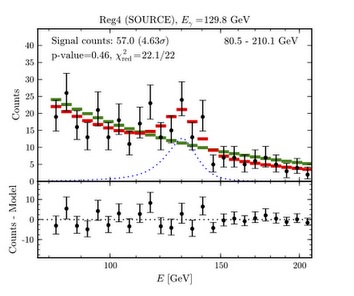
But now just in the past 2 weeks we have an independent author who has examined the publicly available Fermi data for gamma rays emitted from our own Galactic center. He was able to analyze around 3.5 years of data, more than the 2 years’ worth of dwarf galaxy data analyzed. It’s just a little bump in the spectrum (see the central region of the figure below), but he claims to see a positive signal at 130 GeV and with a (marginal) statistical significance just in excess of 3 standard deviations. This is tantalizing, potentially, but not strong enough for a clear detection.

Image

This possible signal is also found at a much higher mass than the neighborhood of 10 GeV where COGENT and DAMA/LIBRA have claimed direct detection in Earth-bound laboratory experiments. The plot thickens and as usual we have to wait for more data from FERMI and other experiments.

http://physicsforme.wordpress.com/2012/04/17/a-tentative-gamma-ray-line-from-dark-matter-annihilation-at-the-fermi-large-area-telescope/

http://arxiv.org/pdf/1204.2797v1.pdf – Preprint by Christoph Weniger, “A Tentative Gamma-Ray Line from Dark Matter Annihilation at the Fermi Large Area Telescope”


Fermi Gamma-ray Telescope Search for Dark Matter

Dwarf Galaxy in Fornax, Credit: ESO/Digital Sky Survey 2

All of our evidence for dark matter is indirect, that is, we deduce the existence of substantial amounts of dark matter – exceeding the amount of ‘ordinary matter’ by 5 times – from its gravitational effects at large distances, on the scale of galaxies, clusters of galaxies, and even across regions of a billion light-years in size.

The generally favored hypothesis is that dark matter is composed of some sort of new weakly interacting massive particle (WIMP). Such a WIMP would not interact via the electromagnetic force or the strong nuclear force, and thus is very hard to detect directly. There are a number of experiments underway attempting to directly detect the elusive particle. The majority of these are earthbound experiments wherein ordinary matter in crystalline form is used as the detector. Three of these experiments are in fact claiming statistically significant detection rates, the DAMA/Libra experiment in Italy, the CRESST experiment based in Germany, and the COGENT experiment in the U.S.

In this class of experiments one is looking to detect a collision of a dark matter particle with an ordinary matter particle, and if detection is successful, to determine the mass of the dark matter particle, as well as its cross-section for collision with ordinary matter. The cross-section is a way of measuring how close the ordinary matter particle and dark matter particle have to approach each other to have a collision event. A collision event produces decay products (additional particles) that the experiments are then able to detect. The results of the 3 experiments named above are still highly controversial, as a number of other similar experiments are not confirming detection, but collectively they may indicate detection of WIMPs with mass in a range around 5 to 40 times the mass of a proton.

Another approach to more directly detecting dark matter (i.e., not through its gravitational effects) is to look for dark matter particles colliding with one another. The number of such events occurring at the Earth’s surface is expected to be quite low, so one must look into the cosmos. Recently some scientists calculated that about one dark matter particle a month on average strikes an atom inside a human on Earth (but not to worry, other background radiation to which we are exposed is much more significant). But we are in a region of over-concentration of ordinary matter; dark matter is spread out on the largest scales. We need to examine much bigger regions to observe dark matter particles striking one another. But look for what, and how?

NASA’s orbiting Fermi Gamma-ray Telescope provides one way. When two dark matter particles collide, depending on the nature of the dark matter particle (is it its own anti-particle), they can possibly mutually annhilate and produce very energetic gamma-ray photons. Gamma rays are at the most energetic end of the electromagnetic spectrum, which includes X-rays, visible light, and radio waves.

Recently the LAT, or Large Area Telescope, which is the main instrument on board the Fermi Gamma-ray Telescope (in orbit) reported on results based on two years of searching for gamma ray production from dark matter annihilation. The method used was to monitor 10 dwarf galaxies that are gravitationally bound to our Milky Way galaxy.

Take a look at this video from NASA Goddard: No WIMPS in Space?

Dwarf galaxies are thought to be good candidates for this type of dark matter search, as they are the remnants of so-called dark matter halos that may have been the first large-scale gravitationally bound objects to form. Larger galaxies in turn grew from multiple such halos coming together, but today’s remaining dwarf galaxies did not get caught up in significant merger activity. They also have mature stellar populations, so there is not a lot of ongoing activity with respect to supernovae or black holes that would produce gamma rays from these other causes.

The international team using the Fermi telescope looked for gamma rays with energies up to 100 billion electron volts (about 100 times the rest mass energy equivalent of a proton), but did not find any that could be clearly attributed to dark matter. The search will continue, gathering more statistics over time and adding additional target dwarf galaxies to their measurements, in the hopes of either finding dark matter through this method, or putting more constraints on its properties.

References:

http://www.cresst.de/darkmatter.php – CRESST experiment

http://cogent.pnnl.gov/ – COGENT experiment

http://people.roma2.infn.it/~dama/web/home.html – DAMA/LIBRA experiment

http://en.wikipedia.org/wiki/Fermi_Gamma-ray_Space_Telescope

http://en.wikipedia.org/wiki/Dark_matter#Direct_detection_experiments

http://www.nasa.gov/mission_pages/GLAST/news/dark-matter-insights.html – Fermi Gamma-ray telescope


Einstein Rings and Dark Matter

Horseshoe-shaped Einstein Ring, Image credit: ESA/Hubble and NASA

Just one hundred years ago, in 1912, Albert Einstein predicted that stars would bend the paths of light in their neighborhood. And in 1919 a team lead by Arthur Eddington confirmed this effect with observations made during a solar eclipse expedition, thus providing confirmation of general relativity (which was published by Einstein in 1915). In 1936 Einstein wrote a paper that showed stars could act as lenses through this gravitational bending of light. The basic idea is that you have a foreground star (or it could as well be a galaxy) and a background star (or galaxy) along nearly the same line of sight.

The effect is much easier to observe with galaxies due to their large masses. As the light travels from the background (more distant) galaxy towards the Earth, it passes very near to the foreground (less distant) galaxy, whose gravitational field causes the light path to bend in accordance with the relativistic curvature of space-time in the neighborhood of the foreground galaxy.

The picture from the Hubble telescope is a very beautiful example of an Einstein ring that has a horseshoe shape. It’s nearly a complete ring, because of the very close alignment of the two galaxies along the line of sight. The foreground galaxy is a large red galaxy, with a mass about 10 times that of our own Milky Way galaxy, and the background source galaxy, whose image is distorted into a horseshoe shape surrounding the red galaxy, is blue in color.

The size of the ring depends on the square root of the mass of the foreground galaxy that acts as a lens. This includes both the ordinary matter and the dark matter associated with the galaxy. Einstein rings thus act as important probes of the distribution of dark matter in the universe.

References:
http://en.wikipedia.org/wiki/Einstein_ring

http://www.spacetelescope.org/images/potw1151a/


Future of Our Runaway Universe (the next Trillion Years)

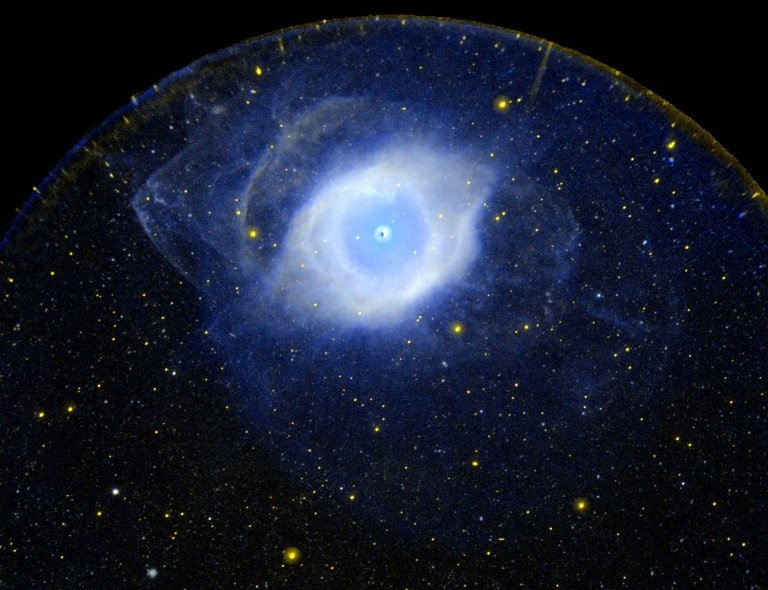
Future for our Sun: Ultraviolet image of the planetary nebula NGC 7293 also known as the Helix Nebula. It is the nearest example of what happens to a star, like our own Sun, as it approaches the end of its life when it runs out of fuel, expels gas outward and evolves into a much hotter, smaller and denser white dwarf star. Image Credit: NASA/JPL-Caltech/SSC

In the future, the average density of matter in the universe (both ordinary matter and dark matter) will continue to drop in proportion to the increasing spatial volume as the universe expands ever more rapidly. The dark energy density, however, behaves differently. Dark energy is an irreducible property of even empty space, so as new space is created, the dark energy density remains the same; it is believed to not only take the same value in all portions of space at a given time, but to also have had the same value (per unit volume) for many billions of years.

Since around 5 billion years ago, when the universe was 9 billion years old, the dark energy has dominated over both types of matter (ordinary and dark) and this dominance is only increasing with the universe’s continued expansion. Today it is 73% of the total mass-energy density and it will approach close to 100% in the future. The assumption is made that the cosmological constant or dark energy term that we measure today remains constant into the future. However it cannot be ruled out that it is changing very slowly or might change suddenly at some future date.

In the cosmological constant case, the scale factor for the size of the universe grows exponentially with time. This is known as the de Sitter solution to the equations of general relativity, and it indicates that the expansion of the universe is accelerating into a runaway condition. There is a single parameter, a timescale. Cosmological measurements indicate that the value is such that the size of the universe for each spatial dimension will double and redouble every 11 billion years (the volume will thus grow by 8 times each 11 billion years).

When the universe is 25 billion years old (now it’s 14 billion years old), distant galaxies will be about twice as far away as today (and 4 times fainter). Well before that time we’ll need to evacuate the Earth as the Sun will go into its red giant phase some 5 billion years from now, followed by a white dwarf phase – as shown in the image of the Helix planetary nebula above. When the universe is around 124 billion years old, distant galaxies on average will be 1000 times farther away from us than now. And after 234 billion years they will be an incredible million times farther away than now!

Year                                    Relative Distance                        Relative Brightness

14 billion (Now)                        1                                                1

25 billion                                    2                                                1/4

124 billion                                  1000                                         one-millionth

234 billion                                  1,000,000                               one-trillionth

The distant galaxies that we detect with the Hubble telescope and large Earth-bound telescopes will become invisible since their apparent luminosity will drop as the square of the increasing distance. For example at the time of 124 billion years, they will be 1 million times fainter (1000 squared). At the time of 234 billion years they will be a trillion times fainter (one million squared). Actually it will be worse than this since their light will be redshifted (stretched out by the cosmological expansion) by the same relative distance factor, so light emitted in the visible will be detected in the millimeter radio region when the universe is 100+ billion years old. This is without considering the evolution in their stellar populations, but only their lower mass, fainter stars will survive, further aggravating the situation.

Galaxies themselves are not changing very much in their size or in internal density, rather it is the spacing between galaxies that is on average growing rapidly. Galaxy groups and clusters that are today gravitationally bound will remain bound. Our home, the Milky Way galaxy, and its large neighbor the Andromeda galaxy, will stay together since they are gravitationally bound, and they may very well merge in several billion years due to tidal effects. All of the 40 or so galaxies and dwarf galaxies in our gravitationally bound Local Group may coalesce after 1 trillion years have passed.

Our light cone horizon, which determines which galaxies are even theoretically visible to us, is shrinking in relative terms. Sufficiently distant galaxies are already receding faster than the speed of light from our vantage point and are entirely hidden from us; if the inflationary model is correct as seems to be the case, the universe is immensely larger than what we are able to detect. This is possible and indeed happening because there are no constraints in special relativity or general relativity on the expansion rate of space itself; only the objects within space are constrained to moving at less than the speed of light relative to their local frames of reference.

An intelligent society in the very distant future, possibly our descendants who have moved to a planet in orbit around another star, would observe only one galaxy, namely their own. This would be a larger galaxy formed from the Milky Way and other members of the Local Group. All other galaxies would no longer be visible, first they would become too distant and too faint, and then they would be entirely beyond our light horizon. These descendants or other observers would believe their galaxy to be the only one in the universe, unless they had access to (and a willingness to believe in) very ancient research publications.

We are fortunate to live in this epoch – despite dark matter, dark energy, and dark gravity, the universe is young, and we are immersed in light.

References:

http://spiff.rit.edu/classes/phys240/lectures/future/future.html

The Five Ages of the Universe, Fred Adams and Greg Laughlin, Simon and Schuster, 1999

The Runaway Universe, Donald Goldsmith, Perseus Books, 2000

Dark Matter, Dark Energy, Dark Gravity, Stephen Perrenod, 2011, https://darkmatterdarkenergy.wordpress.com/where-to-find/


Do we have a CoGeNT direct detection of Dark Matter?

CoGeNT detector during installation

CoGeNT detector during installation (Credit: Pacific Northwest National Laboratories)

(cogent = clear, logical, convincing)

The race to demonstrate direct detection of WIMP (weakly interacting massive particle) dark matter is heating up with this month’s release of results from the CoGeNT experiment, located in a mine in northern Minnesota*. They have just published results collected during the first 15 months of data taking. CoGeNT, as the Ge in the name indicates, uses a detector made of germanium.

There are quite a few such experiments that seek to measure the impact of WIMP dark matter as it directly strikes nucleons, that is, protons and neutrons, in some target material. The cross sections expected for such direct impact are extremely low, thus the experiments require relatively large detectors, high sensitivity, and long runs to gather sufficient statistical evidence of impacts and separate good events from background events due to other causes. The most favored candidate is a WIMP with mass somewhat under 10 GeV to perhaps as high as 200 GeV (the proton rest mass is .938 GeV, a GeV is a billion electron volts, and the mass is stated in energy equivalent units).

While XENON, CDMS (located in the same Soudan laboratory in Minnesota) and other direct experiments have not detected dark matter, for a number of years the DAMA/LIBRA project in Italy has been claiming the detection of an annual modulation of a dark matter signal. The modulation is said to be due to movement of the Earth toward and then away from the galactic center as it orbits the Sun each year, with the signal peaking in the second quarter of the year.

The CoGeNT experiment is also now claiming a detection of an annual modulation with about 2.7 or 2.8 sigma (standard deviations) of statistical significance, which is at the margin of a good detection. DAMA/LIBRA, which uses a thallium-doped sodium iodide crystal (salt) detector, claims a very high statistical significance of 8.9 sigma. Generally, 3 sigma of significance is considered sufficient for a good detection and 5 sigma would be considered a solid detection. The DAMA/LIBRA events have until now been unconfirmed, and have appeared to be in conflict with limits from other experiments including XENON and CDMS.

The CoGeNT results are consistent with DAMA/LIBRA in two respects. First, they together imply a relatively low mass of 5 to 12 GeV for the dark matter WIMP. Second, both the CoGeNT and DAMA experiments are consistent with an annual modulation peak occurring sometime between late April and the end of May, as is expected based on the Earth’s orbit combined with the Sun’s movement relative to the galactic center.

While the CDMS results appear to set limits which contradict both the CoGeNT and DAMA results, there are a number of uncertainties in the actual sensitivity of the respective experiments that may allow resolution of the apparent discrepancy.

We eagerly await further results from CoGeNT and from other experiments including CRESST and COUPP that are well suited to measurement of a relatively low mass WIMP particle such as CoGeNT is claiming to have detected.

*The mine is located in a state park, and tours down into the mine run during the summer months. It is also near to the beautiful Boundary Waters Canoe area that crosses into Canada, where I took a ten day canoe excursion as a Boy Scout, decades ago.

References:


http://www.spacedaily.com/reports/New_data_still_have_scientists_in_dark_over_dark_matter_999.html


http://cogent.pnnl.gov/

C. Aalseth et al. 2011, “Search for an Annual Modulation in a P-type Point Contact Germanium Dark Matter Detector” http://arXiv.org/pdf/1106.0650

D. Hooper and C. Kelso 2011 “Implications of CoGeNT’s New Results for Dark Matter” http://arXiv.org/pdf/1106.1066v1


Dark Matter Powered Stars

Gamma Ray Burster 070125

GRB (gamma ray burster) 070125. Credit: B. Cenko, et al. and the W. M. Keck Observatory.

So what is a “dark star”? It is not a Newtonian black hole as suggested by John Michell in the 18th century who used the term while postulating that gravity could prevent light escaping from a very massive, compact star. It is not a “dark energy star”, which is related to a black hole, but rather than having a singularity at the center, quantum effects cause infalling matter to be converted to vacuum state energy, dark energy. It is not a comic book, science fiction comedy film, or Grateful Dead song.

In this blog entry we are writing about dark matter powered stars. These would be the very first stars, formed within the first few hundred million years of the universe’s existence. The working assumption is that dark matter consists of WIMPs – weakly interacting massive particles, in particular the favored candidate is the neutralino. The neutralino is the lightest particle among the postulated supersymmetric companions to the Standard Model suite of particles. As such it would be stable, would not ordinarily decay and is being searched for with XENON, CDMS, DAMA, AMS-02 and many other experiments.

The first stars are thought by astrophysicists to have been formed from clouds of ordinary hydrogen and helium as well as dark matter, with dark matter accounting for 5/6 of the total mass. These clouds, called “dark matter halos” are considered to have contained from about one million to 100 million times the Sun’s mass. The ordinary matter would settle towards the center as it cooled via radiation processes and the dark matter (which does not radiate) would be more diffuse. The stars forming at the center would be overwhelmingly composed of ordinary matter (hydrogen and helium nuclei and electrons).

Without any dark matter at all, ordinary matter stars up to about 120 to 150 solar masses could form; above this limit they would have very hot surfaces and their own radiation would inhibit further growth by infall of matter from the halo. But if as little as one part in a thousand of the protostar’s mass was in the form of dark matter this limitation goes away. The reason is that the neutralino WIMPs will, from time to time, meet one another inside the star and mutually annihilate since the neutralino is its own anti-particle. The major fraction of the energy produced in the annihilation remains inside the star, but some escapes in the form of neutrinos (not neutralinos).

Annihilation of these neutralinos is a very efficient heating mechanism throughout the volume of the star, creating a great amount of heat and pressure support, basically puffing up the star to a very large size. The stellar surface is, as a result, much cooler than in the no dark matter case, radiation pressure is insignificant, and accretion of significantly more material onto the star can occur. Stars could grow to be 1000 solar masses, or 10,000 solar masses, potentially even up to one million solar masses. Their sizes would be enormous while they were in the dark matter powered phase. Even the relatively small 1000 solar mass star, if placed at the Sun’s location, would extend through much of our Solar System, beyond the orbit of Saturn.

We have mentioned the neutralino meets neutralino annihilation mechanism. A second mechanism for heating the interior of the star would be direct impact of neutralinos onto protons and helium nuclei. This second mechanism could help sustain the duration as a dark matter powered star potentially even beyond a billion years.

Eventually the dark matter fuel would be exhausted, and the heat and pressure support from this source lost. The star would then collapse until the core was hot enough for nuclear fusion burning. Stars of 1000 solar masses would burn hydrogen, and later helium, and evolve extremely rapidly because of the high density and temperature in their cores. After their hydrogen and helium fusion cycles completed there would be no source of sufficient pressure support and they would collapse to black holes (or maybe dark energy stars).

It is calculated with detailed simulations that the dark star mechanism allows for much more massive stars than could be formed otherwise, and this provides a potentially natural explanation for the creation of massive black holes. Our own Milky Way has a black hole around 3 million solar masses at its center, and it appears a majority of galaxies have large black holes. The image at the top of this blog is of a gamma ray burst detection that may have come from a large black hole formation event.

References:

en.wikipedia.org/wiki/Dark_star_(dark_matter)

Freese, K. et al 2008, Dark Stars: the First Stars in the Universe may be powered by Dark Matter Heating, http://arxiv.org/pdf/0812.4844v1

Freese, K. et al 2010, Supermassive Dark Stars, http://arxiv.org/abs/1002.2233

http://news.discovery.com/space/did-dark-stars-spawn-supermassive-black-holes.html


Direct Search for Dark Matter: XENON100

The direct detection of putative dark matter particles, as opposed to measuring their collective gravitational effects, remains a significant challenge. A number of experiments are actively searching for WIMPs (= Weakly Interacting Massive Particles) as the currently favored candidates for dark matter. Particle physics models with supersymmetric extensions to the Standard Model suggest that the most abundant particle of dark matter would have a mass significantly greater than the proton. The mass is expected to lie somewhere in the range of under 10 times the mass of a proton to possibly as much as 10,000 times the mass of a proton (around 10 to 10,000 GeV/c^2 where GeV is a billion electron volts of energy and we divide by the square of the speed of light to convert to mass). The WIMP name reflects that these particles would only interact with other matter via the weak nuclear force and via gravity. They do not react via either the strong nuclear force or electromagnetism.

It is believed that WIMPs are produced in the Big Bang as a decay mode from the massive release of energy during the inflation phase. The currently most favored candidate WIMP is the proposed least massive supersymmetric particle (LSP), which is expected to be stable. Supersymmetric particles are considered to have large masses and would have the same quantum numbers (properties) as corresponding Standard Model particles, except for their spins, that would differ by 1/2 from their partners. The local density of dark matter is estimated to be about .3 GeV / cc (GeV per cubic centimeter). If the WIMP mass is 100 GeV/ c^2 there would be about 3 particles per liter.

Two major techniques are being employed to search for cosmic WIMPs. One of these is to detect the direct impact of WIMPs with atomic nuclei (via elastic scattering) in underground laboratories here on Earth. These would be very rare events, so large detectors are required and experiments must gather data for a long time. Such an impact leaves products from the interaction and it is these products that are actually detected in an experiment. A second technique is to look for gamma rays, which are produced in the galactic halo of the Milky Way or also the Sun’s interior, when dark matter (WIMP) collisions with ordinary matter occur at those locations. The gamma rays produced in this way can in principle be detected with satellites in Earth orbit.

Beyond these two general techniques to detect WIMPs there is the hope of actually creating these dark matter particles via high energy collisions at the Large Hadron Collider.

One recent set of results is from the XENON collaboration, which is funded by the US government and 6 European nations. The XENON100 experiment is located underground in Italy, in the Gran Sasso National Laboratory. The heart of the detector consists of cooled Xenon of quantity 65 kilograms. The target is in both the liquid and gas phases. When a WIMP strikes a Xenon atom directly, electrons are either knocked out of the Xenon atom or boosted to higher energy orbital levels in the atom. Both scintillation light, due to subsequent decay of the electron orbital, and ionization electrons, are thus generated. The 100 days of exposure of XENON100 analyzed to date have yielded 3 events, but one expects 2 events from background neutrons producing similar signatures, so there is statistically no detection. This result does allow the placement of upper limits on the WIMP cross-section for interaction as a function of mass.

The result appears to be in conflict with another experiment, also located at the same Gran Sasso laboratory, run by the DAMA team. The DAMA/Libra experiment claims a statistically significant detection of an annually modulated “WIMP wind” which reflects the variation in the Earth’s orbital direction with respect to the diffuse background of WIMP particles. The intensity is well above XENON100 limits for certain possible mass ranges of the WIMP major constituent particle.

The race is on to secure the direct detection of dark matter particles, beyond their extensive apparent gravitational effects. Rapid progress in enhancing the sensitivity of detection methods, typically including the use of larger detectors, will increase the probability of better WIMP detection and mass determination in the future.

References:

M. Drees, G. Gerbier and the Particle Data Group, 2010. “Dark Matter” Journal of Physics G37(7A) pp 255-260

J. Feng, 2010. Ann. Rev. Astron. Astrophys. 48: 495, “Dark Matter Candidates from Particle Physics and Methods of Detection” (also available at: arxiv.org/pdf/1003.0904)

S. Perrenod, 2011. Dark Matter, Dark Energy, Dark Gravity, chapter 4, BookBrewer Publishing

http://www.wikipedia.org/wiki/Dark_matter

XENON Dark Matter Project


Dark Matter

Dark matter is like the hidden part of an iceberg found below the water line. The hidden part is the dominant portion of the mass and supports the structure apparent from the visible portion above. Dark matter couples to ordinary matter through the gravitational force. The ordinary visible matter, which we detect through light from galaxies and stars, is analogous to the portion of an iceberg above the water line.

Why is dark matter important? It dominates the mass-energy density of the universe during the early part of its lifetime. Just after the epoch of the cosmic microwave background (CMB) the universe is composed of mostly dark matter (dark energy comes to dominate much later, during the most recent 5 billion years). But also there is the ordinary matter, which at that time is a highly uniform gas of hydrogen and helium atoms, with slightly overdense and slightly underdense regions.

The existence of a large amount of dark matter promotes much more efficient gravitational collapse of the overdense regions. This is a self-gravitational process in which regions that are slightly denser than the critical mass density (which is also the average mass density of the universe) at a given time will collapse away from the overall expansion that continues around them. Both the dark and ordinary matter in such a region collapse together, but it is the ordinary matter that forms the first stars since it interacts via various physical processes (think friction, radiation, etc.) to a much greater degree allowing for collapse. The dark matter, interacting only via gravity and perhaps the weak nuclear force, but not through electromagnetism, remains more spread out, more diffuse. The dark matter promotes the collapse process though, through increasing the self-gravity of a given region and this results in more efficient formation of stars and galaxies. There are many more stars and galaxies formed at early times than would be the case in the absence of substantial dark matter.

From cosmological observations including the CMB and high redshift (distant) supernovae, we find dark matter is about 1/4 of the mass-energy density of the universe. Dark matter is composed of either faint ordinary matter or, more likely, exotic matter that interacts through the weak and gravitational forces only. Dark matter is clearly detected by its gravitational effects on galaxy rotation curves, and is inferred from the kinematics of clusters of galaxies and the temperature measures of X-ray emission from very hot gas between galaxies in these same clusters. Dark matter is also detected through gravitational lensing effects in our galactic halo and in very large-scale cosmological structures. The abundance of deuterium, which is produced from Big Bang nucleosynthesis, in conjunction with the universe’s now well-known expansion rate, severely constrains the density of baryons (amount of ordinary nucleonic matter, i.e. protons and neutrons) in the universe and leads to the conclusion that over 80% of matter is nonbaryonic.

The MACHO (MAssive Compact Halo Objects) alternative, which refers to potential ordinary matter, is thus limited. The WIMP (Weakly Interacting Massive Particles) contribution is dominant. Hot WIMPS (e.g. neutrinos) are ruled out because they inhibit clumpiness and galaxy formation in the early universe. Cold nonbaryonic dark matter is the best candidate, with the primary candidate being an hypothesized, undiscovered particle. Neutralinos are thought by many particle physicists to be the best candidate for this, and have an expected mass of order 50 to 250 times the mass of the proton. It must be emphasized that no neutralino or similar particles (known as supersymmetric particles) have ever been detected directly. It is hoped that the Large Hadron Collider newly operational at CERN near Geneva may do this.

There may be direct detection of an annual modulation of the WIMP wind in a large scintillation array. There is also a possible indirect detection which manifests as an excess of 1 GeV gamma rays in our galactic halo. Significantly more sensitive detectors are needed to find these elusive particles and to provide a stronger foundation for supersymmetric physics, which postulates many new and heavy particles. An important experiment AMS-02 (Alpha Magnetic Spectrometer, 2nd generation) is scheduled to be carried to the International Space Station on the last Endeavour Shuttle mission scheduled for April 19, 2011. See http://www.ams02.org and http://cosmiclog.msnbc.msn.com/_news/2011/04/04/6403905-will-space-jam-delay-shuttle-launch

The next decade should allow us to shed new light on dark matter. Whatever it is made of, without the existence of substantial amounts of dark matter, there wouldn’t be nearly as many stars and galaxies in the universe, and we very likely wouldn’t be here.