Tag Archives: Dark matter

X-raying Dark Matter

I was at the dentist this week. Don’t ask, but they took 3 digital X-Rays.

One of the most significant methods by which we detect the presence of dark matter is through the use of X-ray telescopes. The energy associated with these X-rays is typically around an order of magnitude less than those zapped into your mouth when you visit the dentist.

Around 50 years ago scientists at American Science and Engineering flew the first imaging X-ray telescope on a small rocket. At a later date, I worked part-time at AS&E, as we called it, while in graduate school. One major project was a solar X-Ray telescope mounted in SkyLab, America’s first space station. This gave me the wonderful opportunity to work in the control rooms at the NASA Johnson Space Center in Houston.

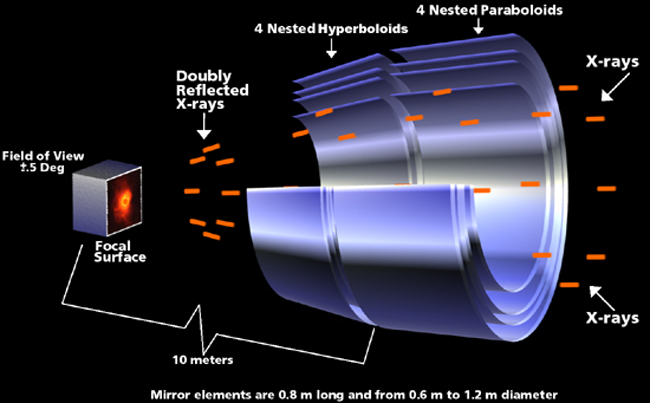
X-rays are absorbed in the Earth’s atmosphere, so today X-ray astronomy is performed from orbiting satellites. X-ray telescopes use the principle of grazing incidence reflection; the X-rays impinge at shallow angles onto gold or iridium-coated metallic surfaces and are reflected to the focal plane and the detector electronics.
cxcmirrors-72

Schematic of grazing incidence mirrors used in the Chandra X-ray Observatory. Credit NASA/CXC/SAO; obtained from chandra.harvard.edu.

How does dark matter result in X-rays being produced? Indirectly, as a consequence of its gravitational effects.

One of the main mechanisms for X-ray production in the universe is known as thermal bremsstrahlung. Bremsstrahlung is a German word meaning ‘decelerated radiation’. A gas which is hot enough to give off X-rays will be ionized. That is, the electrons will be stripped from the nuclei and move about freely. As electrons fly around near ions (protons and helium nuclei primarily) their mutual electromagnetic attraction will result in some of the electrons’ kinetic energy being transferred to radiation.

The speed at which the electrons are moving around determines how energetic the produced photons will be. We talk about the temperature of such an ionized gas, and that is proportional to the square of the average speed of the electrons. A gas with a temperature of 10 million degrees will give off approximately 1 kiloVolt X-rays (hereafter we use the KeV abbreviation), and a gas with a temperature of 100 million degrees will radiate 10 KeV X-rays. One eV converts to 11,605 degrees Kelvin (or we can just say Kelvins).

ChandrainColumbiabay

Chandra X-ray Observatory prior to launch in the Space Shuttle Columbia in 1999. NASA image.

So how can we produce gas hot enough to give off X-Rays by this mechanism? Gravity, and lots of it. The potential energy of the gravitational field is proportional to the amount of matter (total mass) coalesced into a region and inversely proportional to the characteristic scale of that region. GM/R, simple Newtonian mechanics, is sufficient; no general relativistic calculation is needed at this point. G is the gravitational constant and M and R are the cluster mass and characteristic radius, respectively.

A lot of mass in a confined region – how about large groups of clusters and galaxies? It turns out we need of order 1000 galaxies for a rich cluster and this will do the trick. But only because there is dark matter as well as ordinary matter. There are three main matter components to consider: galaxies, hot intracluster gas found between galaxies, and dark matter. The cluster forms from gravitational self-collapse from a region that was of above average density in the early universe. All the over dense regions are subject to collapse.

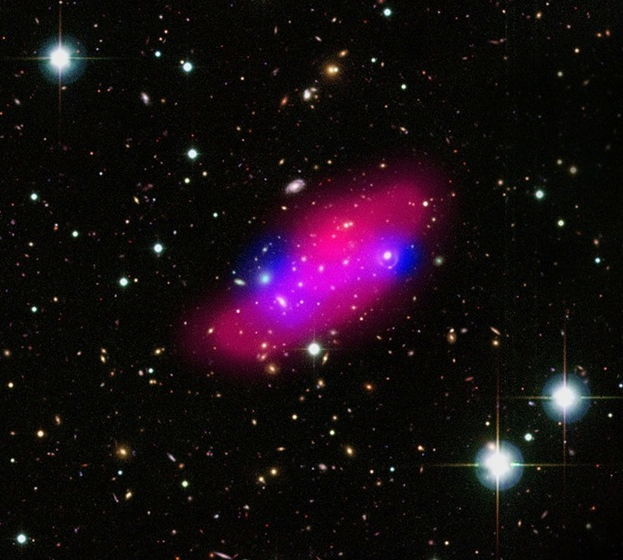
darkmatter.bulletcluster

The “Bullet Cluster” is actually two colliding clusters. The bluish color shows the distribution of dark matter as determined from the gravitational lensing effect on background galaxy images. The reddish color depicts the hot X-ray emitting gas measured by the Chandra X-ray Observatory.

(X-ray: NASA/CXC/CfA/M.Markevitch Optical: NASA/STScI; Magellan/U.Arizona/D.Clowe Lensing Map: NASA/STScI; ESO WFI; Magellan/U.Arizona/D.Clowe)

The optically visible galaxies are the least important contributor to the cluster mass, only around 1%! Galaxy clusters are made of dark matter much more than they are made out of galaxies. And secondarily, they are made out of hot gas. The ordinary matter contained within galaxies is only the third most important component. The table below gives the typical 90 / 9 / 1 proportions for dark matter, hot gas, and galaxies, respectively.

Three main components of a galaxy cluster (Table derived from Wikipedia article on galaxy clusters)

Component                      Mass fraction             Description

Galaxies                           1%                         Optical/infrared observations

Intergalactic gas              9%                         High temperature ionized gas – thermal bremsstrahlung

Dark matter                     90%                        Dominates, inferred through gravitational interactions

The intracluster gas has two sources. A major portion of it is primordial gas that never formed galaxies, but falls into the gravitational potential well of the cluster. As it falls in toward the cluster center, it heats. The kinetic energy of infall is converted to random motions of the ionized gas. An additional portion of the gas is recycled material expelled from galaxies. It mixes with the primordial gas and heats up as well through frictional processes. The gas is supported against further collapse by its own pressure as the density and temperature increase in the cluster core.

The temperature which characterizes the X-ray emission is a measure of gravitational potential strength and proportional to the ratio of the mass of the cluster to its size. Typical X-Ray temperatures measured for rich clusters are around 3 to 12 KeV, which corresponds to temperatures in the range of 30 to 130 million Kelvins.

There is another way to measure the strength of the cluster’s gravitational potential well. That is by measuring the speed of galaxies as they move around in somewhat random fashion inside the cluster. The assumption, which is valid for well-formed clusters after they have been around for billions of years, is that the galaxies are not just falling into the center of the cluster, but that their motions are “virialized”. This is the method used by Fritz Zwicky in the 1930s for the original discovery of dark matter. He found that in a certain well known cluster, the Coma cluster, that the average speed of galaxies relative to the cluster centroid was of order 1000 kilometers/sec, much higher than the expected 300 km/sec based on the visible light from the cluster galaxies. This implied 10 times as much dark matter as galactic matter. This early, rather crude measurement, was on the right track, but fell short of the actual ratio of dark matter to galactic matter since we now know that galaxies themselves have large dark matter halos. The X-ray emission from clusters was discovered much later, starting in the 1970s.

The two methods of measuring the amount of dark matter in Galaxy clusters generally agree. Both the galaxies and the hot intracluster gas are acting as tracers of the overall mass distribution, which is dominated by dark matter. Galaxy clusters play a major role in increasing our understanding of dark matter and how it affects the formation and evolution of galaxies.

In fact if dark matter was not 5 times as abundant by mass as ordinary matter, most galaxy clusters would never have formed, and galaxies such as our own Milk Way would be much smaller.

References

Wikipedia article “galaxy clusters”.

“X-ray Temperatures of Distant Clusters of Galaxies”, S. C. Perrenod,  J. P. Henry 1981, Astrophysical Journal, Letters to the Editor, vol. 247, p. L1-L4.

“The X-ray Luminosity – Velocity Dispersion Relation in the REFLEX Cluster Survey”, A. Ortiz-Gil, L. Guzzo, P. Schuecker, H. Boehringer, C.A. Collins 2004, Mon.Not.Roy.Astron.Soc. 348, 325; http://arxiv.org/abs/astro-ph/0311120v1


Super Colliders in Space: Dark Matter not Colliding

What’s bigger and more powerful than the Large Hadron Collider at CERN? Why colliding galaxy clusters of course.

A cluster of galaxies consists of hundreds or even thousands of galaxies bound together by their mutual gravitation. Both dark matter and ordinary matter in and between galaxies is responsible for the gravitational field of a cluster. And typically there is about 5 times as much dark matter as ordinary matter. The main component of ordinary matter is hot intracluster gas; only a small percentage of the mass is locked up in stars.

One stunning example of dark matter detection is the Bullet Cluster. This is the canonical example found revealing dark matter separation from ordinary matter in a pair of clusters colliding and merging. The dark matter just passes right through, apparently unaffected by the collision. The hot gas (ordinary matter) is seen through its X-ray emission, since the gas is heated by collisions to of order 100 million degrees. The Chandra X-ray Observatory (satellite) provided these measurements.

Image courtesy of Chandra X-ray Observatory

Bullet Cluster. The blue color shows the distribution of dark matter, which passed through the collision without slowing down. The purple color shows the hot X-ray emitting gas. Image courtesy of Chandra X-ray Observatory

The distribution of matter overall in the Bullet Cluster or other clusters is traced by gravitational lensing effects; general relativity tells us that  background galaxies will have their images displaced, distorted, and magnified as their light passes through a cluster on its way to Earth. The magnitude of these effects can be used to “weigh” the dark matter. These measurements are made with the Hubble Space Telescope.

In the Bullet Cluster the dark matter is displaced from the ordinary matter. The interpretation is that the ordinary matter from the two clusters, principally in the form of hot gas, is slowed by frictional, collisional processes as the clusters interact and form a larger single cluster of galaxies. Another six or so examples of galaxy clusters showing the displacement between the dark matter and the ordinary matter in gas and stars have been found to date.

Now, a team of astrophysicists based in the U.K. and Switzerland have examined 30 additional galaxy clusters with data from both Chandra and Hubble, and with redshifts typically 0.2 to 0.6. In aggregate there are 72 collisions in the 30 systems, since some have more than two subclusters. The offsets between the gas and dark matter are quite substantial, and in aggregate indicate the existence of dark matter in these clusters with over 7 standard deviations of statistical significance (probability of the null hypothesis of no dark matter is 1 in 30 trillion).

They then look at the possible drag force on the dark matter due to dark matter particles colliding with other dark matter particles. There are already much more severe constraints on ordinary matter – dark matter interactions from Earth-based laboratory measurements. But the dark matter mutual collision cross section could potentially be large enough to result in a drag. They measure the relative positions of hot gas, galaxies, and dark matter for all of the 72 subclusters.

From paper "The non-gravitational interactions of dark matter in colliding galaxy clusters"

From paper “The non-gravitational interactions of dark matter in colliding galaxy clusters” D. Harvey et al. 2015

The gas should and does lag the most, relative to the direction of the galaxies in a collision. If there is a dark matter drag, then dark matter should lag behind the positions of the stars. They find no lag of the dark matter average position, which allows them to place a new, tighter constraint on the mutual interaction cross-section for dark matter.

Their constraint is σ(DM)/m < 0.47 cm^2/g at 95% confidence level, where σ (sigma) is the cross-section and m is the mass of a single dark matter particle. This limit is over twice as tight as that previously obtained from the Bullet Cluster. And some dark matter models predict a cross section per unit mass of 0.6 cm^2/g, so these models are potentially ruled out by these new measurements.

In summary, using Nature’s massive particle colliders, the authors have found further highly significant evidence for the existence of dark matter in clusters of galaxies, and they have placed useful constraints on the dark matter self-interaction cross-section. Dark matter continues to be highly elusive.

Reference:

D. Harvey et al. 2015 “The non-gravitational interactions of dark matter in colliding galaxy clusters” http://arxiv.org/pdf/1503.07675v1.pdf


Discovery of several dwarf galaxies near the Magellanic Clouds

Dwarf galaxies are, as the name implies, small or even tiny galaxies with much lower mass and luminosity than large galaxies such as our own Milky Way galaxy or the Andromeda galaxy or Triangulum galaxy. The first two galaxies are the dominant members of our Local Group of galaxies, which has over 50 members. While the Milky Way and Andromeda have over 200 billion stars each, most all of the others are much smaller and intrinsically fainter, and thus are considered dwarf galaxies. Around half of these known dwarf galaxies are companions to our Milky Way, and the rest are companions of Andromeda.

x-default

Previously known dwarf satellite galaxies around our Milky Way galaxy are shown as blue dots and the 9 new candidates are shown as red dots. Image: Yao-Yuan Mao, Ralf Kaehler, Risa Wechsler (KIPAC/SLAC).

The Dark Energy Survey “powered up” in the second half of 2013. Using the Dark Energy  Camera at the Cerro Tololo Inter-American observatory in Chile, two teams of astronomers have now made a stunning discovery of 9 new dwarf objects in the vicinity of, and gravitationally bound to, our own Milky Way. Three of these are confirmed to be dwarf galaxies. The other six objects are either dwarf galaxies or globular clusters, and further observations will be required to determine how many of these are indeed dwarf galaxies.

These new dwarf galaxies and dwarf galaxy candidates were found in the vicinity of the Magellanic Clouds, in the Southern Hemisphere. Those are themselves the two best known of all dwarf galaxies, but are substantially brighter and larger than these new dwarf galaxy candidates. In fact it is possible, but not certain, that the newly discovered dwarf galaxies have interacted with one or both of the Magellanic Clouds in the past.

This discovery of 3 or more new dwarf galaxies near to our Milky Way, in the range of about 100,000 light-years to 1.2 million light-years away from us, has important implications for our understanding of dark matter and cosmology generally. We know from a wide range of observations, including the latest Planck satellite results, that dark matter is 5 times more common than ordinary matter in the universe.

Dark matter and ordinary matter are distributed differently. Think of dark matter as the scaffolding which controls the overall distribution of matter at large scale. Ordinary matter is thus controlled gravitationally by the dark matter background. But ordinary matter also clumps together at smaller scales because as it collapses (falls into a gravitational potential well) it heats up via frictional processes. Next it radiates away energy, leading to cooling, and thus further collapse. This is how we end up with galaxies and stellar formation.

Large galaxies will be dominated by ordinary matter toward their centers, but by dark matter in their outer regions and halos. Many dwarf galaxies appear to have few stars, as little as only a few thousand, reflecting quite modest amounts of ordinary matter. These galaxies are heavily dominated by dark matter, sometimes 99% or more.

There is a whole theory of galaxy formation based on the growth of dark matter-dominated density perturbations that collapse under their own gravity, even while the universe as a whole is expanding. Ordinary matter is pulled into the regions of high dark matter density, leading to galaxy formation. Low density regions do not collapse, but keep on expanding in,the “Hubble flow”.

Numerical simulations of the growth of these dark matter density perturbations and of galaxy formation suggest there should be large numbers of dwarf galaxies. As we continue to discover more dwarf galaxies in the vicinity of our Milky Way, through the Dark Energy Survey and other experiments, our confidence in our understanding of cosmology and of galactic formation and evolution will continue to grow.

References

http://www.cnet.com/news/our-new-neighbours-rare-dwarf-galaxies-found-orbiting-the-milky-way/  – CNET article

http://www.cam.ac.uk/research/news/welcome-to-the-neighbourhood-new-dwarf-galaxies-discovered-in-orbit-around-the-milky-way – Article at University of Cambridge astronomy web site

http://www.fnal.gov/pub/presspass/press_releases/2015/DES-Dwarf-Galaxies-20150310.html – Article at Fermilab web site (home of the Dark Energy Survey)

http://www.darkenergysurvey.org – Dark Energy Survey web site

http://arxiv.org/abs/1503.02079 – S. Koposov, V. Belokurov, G. Torrealba, N. Wyn Evans, ”Beasts of the Southern Wild. Discovery of a large number of Ultra Faint satellites in the vicinity of the Magellanic Clouds”


Planck Mission Full Results Confirm Canonical Cosmology Model

Dark Matter, Dark Energy values refined

The Planck satellite, launched by the European Space Agency, made observations of the cosmic microwave background (CMB) for a little over 4 years, beginning in August, 2009 until October, 2013.

Preliminary results based on only the data obtained over the first year and a quarter of operation, and released in 2013, established high confidence in the canonical cosmological model. This ΛCDM (Lambda-Cold Dark Matter) model is of a topologically flat universe, initiated in an inflationary Big Bang some 13.8 billion years ago and dominated by dark energy (the Λ component), and secondarily by cold dark matter (CDM). Ordinary matter, of which stars, planets and human beings are composed, is the third most important component from a mass-energy standpoint. The amount of dark energy is over twice the mass-energy equivalent of all matter combined, and the dark matter is well in excess of the ordinary matter component.

The_history_of_the_Universe

This general model had been well-established by the Wilkinson Microwave Anisotropy Probe (WMAP), but the Planck results have provided much greater sensitivity and confidence in the results.

Now a series of 28 papers have been released by the Planck Consortium detailing results from the entire mission, with over three times as much data gathered. The first paper in the series, Planck 2015 Results I, provides an overview of these results. Papers XIII and XIV detail the cosmological parameters measured and the findings on dark energy, while several additional papers examine potential departures from a canonical cosmological model and constraints on inflationary models.

In particular they find that:

Ωb*h²  = .02226 to within 1%.

In this expression Ωb is the baryon (basically ordinary matter) mass-energy fraction (fraction of total-mass energy in ordinary matter) and h = H0/100. H0 is the Hubble constant which measures the expansion rate of the universe, and indirectly, its age. The best value for H0 is 67.8 kilometers/sec/Megaparsec  (millions of parsecs, where 1 parsec = 3.26 light-years). H0 has an uncertainty of about 1.3% (two standard deviations). In this case h = .678 and the expression above becomes:

Ωb = .048, with uncertainty around 3% of its value. Thus, just under 5% of the mass-energy density in the universe is in ordinary matter.

The cold matter density is measured to be:

Ωc*h²  = .1186 with uncertainty less than 2% and with the h value substituted we have Ωc = .258 with similar uncertainty.

Since the radiation density in the universe is known to be very low, the remainder of the mass-energy fraction is from dark energy,

Ωe = 1 – .048 – .258 = .694

So in approximate percentage terms the Planck 2015 results indicate 69% dark energy, 26% dark matter, and 5% ordinary matter as the mass-energy balance of the universe. These results are essentially the same as the ratios found from the preliminary results reported in 2013. It is to be emphasized that these are present-day values of the constituents. The components evolve differently as the universe expands. Dark energy is manifested with its current energy density in every new unit of volume as the universe continues to expand, while the average dark matter and ordinary matter densities decrease inversely as the volume grows. This implies that in the past, dark energy was less important, but it will dominate more and more as the universe continues to expand.

Why is dark energy produced as the universe expands? The simplest explanation is that it is the irreducible quantum energy of empty space, of the vacuum. Empty space – space with no particles whatsoever – still has fields (scalar fields, in particular) permeating it, and these fields have a minimum energy. It also has ‘virtual’ particles popping in and out of existence very briefly. This is the cosmological constant (Λ) model for the dark energy.

This is the ultimate free lunch in nature. The dark energy works as a negative gravity; it enters into the equations of general relativity as a negative pressure which causes space to expand. And as space expands, more dark energy is created! A wonderful self-reinforcing process is in place. Since the dark energy dominates over matter, the expansion of the universe is accelerating, and has been for the last 5 billion years or so. Why wonderful? Because it adds billions upon billions of years of life to our universe.

The Planck Consortium also find the universe is topologically flat to a very high degree, with an upper limit of 1/2 of 1% deviation from flatness at large scales. This is an impressive observational result.

One of the most interesting results is Planck’s ability to constrain inflationary models. While a massive inflation almost certainly happened during the first billionth of a trillionth of a trillionth of a second as the Universe began, as indicated by the very uniformity of the CMB signal, there are many possible models of the inflationary field’s energy potential.

We’ll take a look at this in a future blog entry.


Milky Way Dark Matter Halo Loses ‘Weight’

640px-Milky_Way_ArchMilky Way Arch, CC BY 3.0Bruno Gilli/ESOhttp://www.eso.org/public/images/milkyway/

Mass estimates for our Milky Way vary widely, from less than 1 trillion, to as high as 4 trillion, times the mass of the Sun.

A recent paper by a group of astronomers in Australia argues for a mass that is very much at the low end of this range. Prajawal Kafle and collaborators present a kinematic analysis and build a model of the Milky Way that incorporates a disk, a bulge, and a dark matter halo. The analysis utilizes K giant and horizontal branch star catalogs.

The disk component – in which our Sun resides – contains stars and gas and active star formation from this gas. The spheroidal bulge contains the oldest stellar population of the galaxy, including globular clusters. The spherical halo, significantly larger and more massive than both the other components, is dominated by dark matter. It is chiefly responsible for the overall gravitational potential of the Milky Way, and is evidenced by the high rotational velocity of our galaxy in its outer regions.

The result of their analysis is that the dark matter halo “weighs in” at about 800 billion solar masses, the disk is about 100 billion solar masses, and the bulge is only about 10 billion solar masses. They also find a dark matter density in the solar neighborhood equivalent to about 1/3 of a proton per cubic centimeter, consistent with other estimates. (This number is important for calibrating Earth-bound direct detection experiments for dark matter.)

The relatively low mass they determine for the dark matter halo implies fewer satellite galaxies in close proximity to the Milky Way. We see only 3, the two Magellanic Clouds and the Sagittarius Dwarf Galaxy. In the past this has been seen as an issue for the favored Lambda – Cold Dark Matter (ΛCDM) Cosmology.

However their lower halo mass is actually consistent with the Milky Way gathering only 3 so-called sub-halos (satellite galaxies) and thus there may be no Missing Satellite Problem with ΛCDM. Some had suggested warm dark matter, rather than cold dark matter, may be necessary because of the putative missing satellite problem, but this may not be the case, with a lighter Milky Way dark matter halo.

Another team, Penarrubia and collaborators, has recently modeled the dynamics of the Local Group of galaxies. They are thus using a different methodology to determine the total mass of the Milky Way. They find a total mass for the Local Group of 2.3 trillion solar masses. The Local Group mass is almost entirely due to the Andromeda Galaxy and our Milky Way. They also determine a Milky Way to Amdromeda mass ratio of about 1/2. This implies a mass of about 0.8 trillion solar masses for our Milky Way, consistent with the Australian team’s result.

These two latest measurements of the Milky Way mass seem to indicate that the total mass of the Milky Way galaxy is less than 1 trillion solar masses. And these two results thus suggest that the ΛCDM cosmology is in fact consistent with the small number of satellite galaxies around our Milky Way. Another success for ΛCDM, it seems.

References:

http://article.wn.com/view/2014/10/10/Milky_Way_has_only_half_of_the_Dark_Matter_than_thought_earl/

http://arxiv.org/pdf/1408.1787v1.pdf – P. Kafle et al. 2014, “On the shoulders of giants: Properties of the stellar halo and Milky Way mass distribution”

J. Penarrubia et al. 2014, Monthly Notices of the Royal Astronomical Society, 443, 2204, “A dynamical model of the local cosmic expansion”


Dark Matter: Made of Sterile Neutrinos?

BulletGroup.XMM

Composite image of the Bullet Group showing galaxies, hot gas (shown in pink) and dark matter (indicated in blue). Credit: ESA / XMM-Newton / F. Gastaldello (INAF/IASF, Milano, Italy) / CFHTLS 

What’s more elusive than a neutrino? Why a sterile neutrino, of course. In the Standard Model of particle physics there are 3 types of “regular” neutrinos. The ghost-like neutrinos are electrically neutral particles with 1/2 integer spins and very small masses. Neutrinos are produced in weak interactions, for example when a neutron decays to a proton and an electron. The 3 types are paired with the electron and its heavier cousins, and are known as electron neutrinos, muon neutrinos, and tau neutrinos (νe, νμ, ντ).

A postulated extension to the Standard Model would allow a new type of neutrino, known as a sterile neutrino. “Sterile” refers to the fact that this hypothetical particle would not feel the standard weak interaction, but would couple to regular neutrino oscillations (neutrinos oscillate among the 3 types, and until this was realized there was consternation around the low number of solar neutrinos detected). Sterile neutrinos are more ghostly than regular neutrinos! The sterile neutrino would be a neutral particle, like other neutrino types, and would be a fermion, with spin 1/2. The number of types, and the respective masses, of sterile neutrinos (assuming they exist) is unknown. Since they are electrically neutral and do not feel the standard weak interaction they are very difficult to detect. But the fact that they are very hard to detect is just what makes them candidates for dark matter, since they still interact gravitationally due to their mass.

What about regular neutrinos as the source of dark matter? The problem is that their masses are too low, less than 1/3 of an eV (electron-Volt) total for the three types. They are thus “too hot” (speeds and velocity dispersions too high, being relativistic) to explain the observed properties of galaxy formation and clumping into groups and clusters. The dark matter should be “cold” or non-relativistic, or at least no more than “warm”, to correctly reproduce the pattern of galaxy groups, filaments, and clusters we observe in our Universe.

Constraints can be placed on the minimum mass for a sterile neutrino to be a good dark matter candidate. Observations of the cosmic microwave background and of hydrogen Lyman-alpha emission in quasar spectra have been used to set a lower bound of 2 keV for the sterile neutrino’s mass, if it is the predominant component of dark matter. A sterile neutrino with this mass or larger is expected to have a decay channel into a photon with half of the rest-mass energy and a regular (active) neutrino with half the energy.

A recent suggestion is that an X-ray emission feature seen at 3.56 keV (kilo-electron Volts) from galaxy clusters is a result of the decay of sterile neutrinos into photons with that energy plus active (regular) neutrinos with similar energy. This X-ray emission line has been seen in a data set from the XMM-Newton satellite that stacks results from 73 clusters of galaxies together. The line was detected in 2 different instruments with around 4 or 5 standard deviations significance, so the existence of the line itself is on a rather strong footing. However, it is necessary to prove that the line is not from an atomic transition from argon or some other element. The researchers argue that an argon line should be much, much weaker than the feature that is detected.

In addition, a second team of researchers, also using XMM-Newton data have claimed detection of lines at the same 3.56 keV energy in the Perseus cluster of galaxies as well as our neighbor, the Andromeda galaxy.

There are no expected atomic transition lines at this energy, so the dark matter decay possibility has been suggested by both teams. An argon line around 3.62 KeV is a possible influence on the signal, but is expected to be very much weaker. Confirmation of these XMM-Newton results are required from other experiments in order to gain more confidence in the reality of the 3.56 keV feature, regardless of its cause, and to eliminate with certainty the possibility of an atomic transition origin. Analysis of stacked galaxy cluster data is currently underway for two other X-ray satellite missions, Chandra and Suzaku. In addition, the astrophysics community eagerly awaits the upcoming Astro-H mission, a Japanese X-ray astronomy satellite planned for launch in 2015. It should be able to not only confirm the 3.56 keV X-ray line (if indeed real), but also detect it within our own Milky Way galaxy.

Thus the hypothesis is for dark matter composed primarily of sterile neutrinos of a little over 7.1 keV in mass (in E = mc^2 terms), and that the sterile neutrino has a decay channel to an X-ray photon and regular neutrino. Each decay product would have an energy of about 3.56 keV. Such a 7 keV sterile neutrino is plausible with respect to the known density of dark matter and various cosmological and particle physics constraints. If the dark matter is primarily due to this sterile neutrino, then it falls into the “warm” dark matter domain, intermediate between “cold” dark matter due to very heavy particles, or “hot” dark matter due to very light particles.

The abundance of dwarf satellite galaxies found in the Milky Way’s neighborhood is lower than predicted from cold dark matter models. Warm dark matter could solve this problem. As Dr. Abazajian puts in in his recent paper “Resonantly Produced 7 keV Sterile Neutrino Dark Matter Models and the Properties of Milky Way Satellites”

the parameters necessary in these models to produce the full dark matter density fulfill previously determined requirements to successfully match the Milky Way galaxy’s total satellite abundance, the satellites’ radial distribution, and their mass density profile..


Axions as Cold Dark Matter

WIMP (weakly interacting massive particle) searches have been getting more frustrating. The LHC, as of yet, has found no evidence for supersymmetric extensions to the Standard Model for particle physics. The least massive supersymmetric particle, if it exists, is a favored WIMP candidate. But detection limits on WIMPs from several experiments are becoming more severe, and are in conflict with other possible or claimed detections. One way out of this quandary may be that there is more than one type of WIMP particle responsible for dark matter (prior blog).

Or perhaps the dominant dark matter constituent is not a WIMP at all. Baryons (ordinary matter) only contribute 1/5 of the total mass, and only 5% of the total mass-energy of the universe. The dark matter component cannot be baryons – this is ruled out by the abundances of deuterium, helium, and lithium generated via nucleosynthesis during the first few minutes of the Big Bang.

Dark matter must be “cold” that is, moving at low to moderate speeds, based on the way galaxies are distributed and cluster together. If dark matter is not due to baryons and not due to WIMPs, what other alternative is there? Neutrinos and other known light particles are ruled out by observations.

But there is another light particle, the axion, which has not been observed, yet is a good candidate as a “weakly interacting light particle” explanation for dark matter. Axions do not require the existence of supersymmetry. They have a strong theoretical basis in the Standard Model as an outgrowth of the necessity to have charge conjugation plus parity conserved in the strong nuclear force (quantum chromodynamics of quarks, gluons). This conservation property is known as CP-invariance. (While CP-invariance holds for the strong force, the weak force is CP violating).

The neutron, composed of three quarks, is observed to have no electric dipole moment, to very high accuracy, indicating CP-invariance holds for the strong force. An additional mechanism (field) is required to “enforce” the invariance. Initial theoretical work was done by Nobel winning physicists Weinberg and Wilczek in the 1970s. The axion is the corresponding particle for this field, providing the favored explanation for allowing the preservation of CP-invariance.

The axion, if it exists, has a very low mass, in the range of over 1 micro-eV to as much as 10 milli-eV. (One eV, or electron-Volt is the energy from moving one electron through a potential of one Volt). By comparison, electron neutrino masses are less than 2 eV, but axions are probably a thousand or more times lighter than the elusive neutrino.

Image

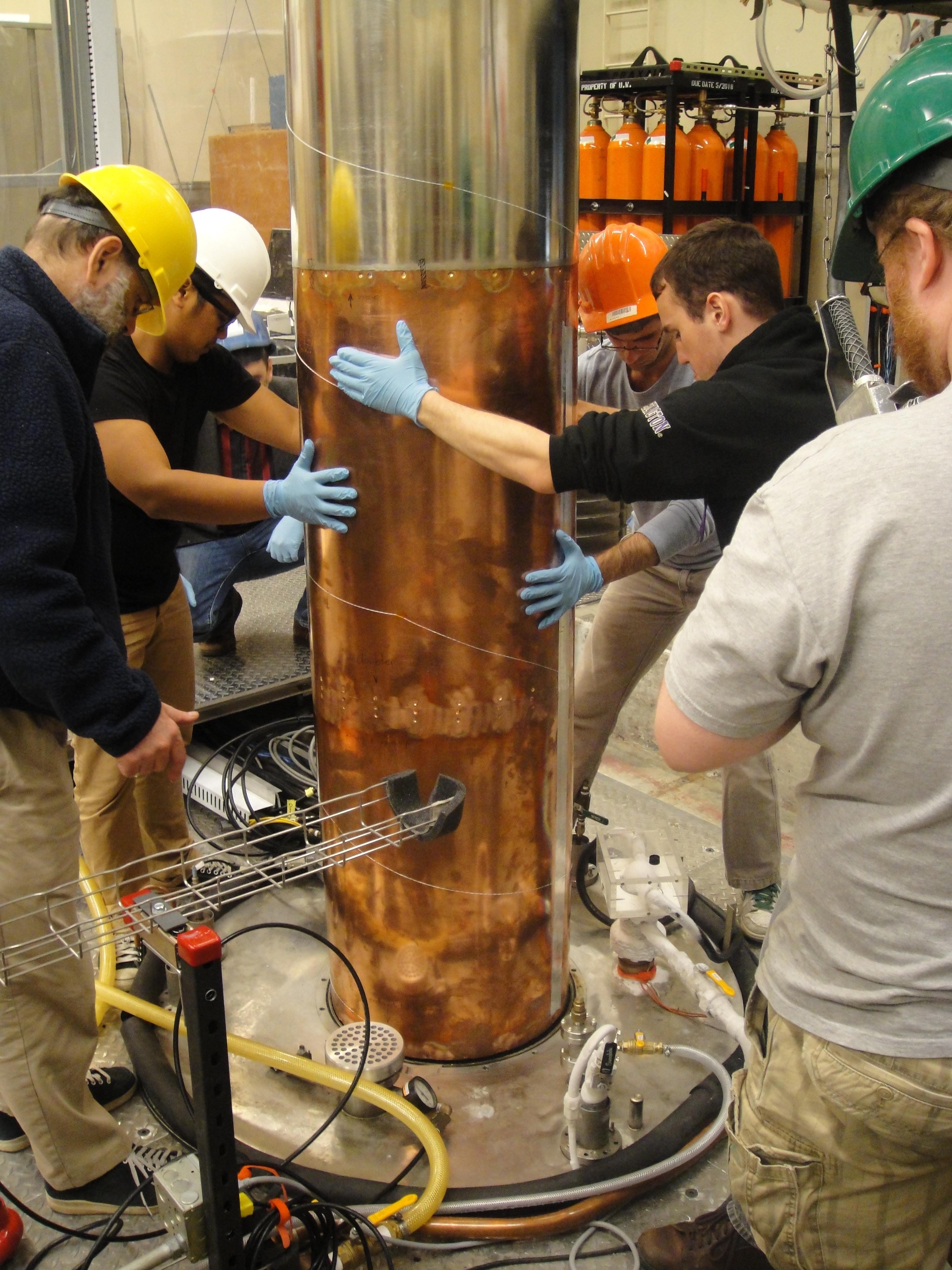
Installation of the insert chamber into the magnet of the ADMX, October 4, 2013.

The Axion Dark Matter Experiment (ADMX) at the University of Washington is the best known experiment searching for axions as a principal component of dark matter. It relies on the prediction that axions can be converted to photons in the presence of a magnetic field. A well-designed experiment requires a large microwave cavity at very low temperature to minimize noise, and with a strong magnetic field. ADMX consists of a microwave cavity surrounded by an 8 Tesla magnet and cooled to liquid helium temperatures.

ADMX has not yet detected axions, but it has placed limits on their interaction cross-section for masses in the range of about 2 to 3 micro-eV. These limits are consistent with the two most popular theoretical models. The ADMX team is in the process of upgrading the apparatus to a sensitivity that would allow them to detect axions if they adhere to one of the two main axion dark matter models, and have mass less than 10 micro-eV. They are scheduled to be able to reach this goal by the end of 2015.

Another interesting possibility is that 110 micro-eV axions may explain an anomalous signal seen in an experiment with Josephson junctions, and thus are already detected. Josephson junctions consist of two superconducting elements separated by an insulating layer. If the axion mass is resonant with the junction frequency, a current spike would occur. An exceptionally high noise spike in one such prior experiment could conceivably be due to an axion resonance signal. We await further experiments to see if the behavior can be repeated at the same frequency.

And for fun, here’s an historical perspective on the axion, from the 1960s, featuring Arthur Godfrey:


References:

http://www.phys.washington.edu/groups/admx/home.html – ADMX web site

https://commons.lbl.gov/download/attachments/88868578/rybka_taup_2013.pdf?version=1&modificationDate=1378925423266 – talk by Gray Rybka from the ADMX team

http://arstechnica.com/science/2013/12/could-dark-matter-be-hiding-in-plain-sight-in-existing-experiments/ – Josephson junction anomaly


2013 in review

The WordPress.com stats helper monkeys prepared a 2013 annual report for this blog.

Here’s an excerpt:

A New York City subway train holds 1,200 people. This blog was viewed about 4,900 times in 2013. If it were a NYC subway train, it would take about 4 trips to carry that many people.

Click here to see the complete report.


Dark Matter Eludes LUX

The LUX (Large Underground Xenon) experiment has just announced results from their first run, which gathered data for 85 days between April and August of this year. LUX is located a mile underground (to shield from cosmic rays and other interference) in an old mine in South Dakota, and employs a liquid Xenon detector with total mass of 370 kg. LUX is searching for WIMP dark matter particles which recoil directly off the nucleus of Xenon atoms in the detector.

Image

Large Underground Xenon detector, Photo by Carlos Faham, CC Attribution 3.0 license

They have two important findings from this first swath of data. First, to within the sensitivity of their experiment, they detected no weakly interacting massive dark particles (WIMPs). And second, their experiment has much greater sensitivity than other experiments in the low mass range from about 5 GeV to 100 GeV (the proton rest mass is a bit less than 1 GeV). Thus it is placing much tighter constrains on the cross-section for dark matter to interact with a nucleus, and the density of dark matter at the Earth’s orbit. The previous largest Xenon-based experiment was XENON100 (for 100 kg total detector mass). With LUX, the sensitivity has improved over the results of that earlier experiment by around a factor of 20 for a possible 10 GeV WIMP mass, due to the larger target and better rejection of background events.

Image

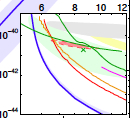
This chart is the most interesting portion of Fig. 5 from the LUX first results paper (reference below). The blue line shows the upper limit on the cross section dropping from 10^-40 cm² to less than 10-44 cm² as a function of WIMP mass, as the mass increases from about 5 to 12 GeV (X-axis above the chart). Note the Y-axis is logarithmic, so the new limit is orders of magnitude below other limits (various colored curves) and claimed possible detections (shaded areas).

These new LUX results are in direct conflict with possible detections from CoGeNT (small red-shaded area on chart), CRESST (yellow-shaded), CDMS- II (green-shaded area), and DAMA/LIBRA (grey-shaded area), all of which were suggesting detections with a WIMP dark matter mass around 10 GeV. Now certain assumptions are made about the astrophysical parameters such as the density of dark matter at the Earth being the same as the average in our part of the galaxy. But other experimental results are based on similar assumptions, so this does not explain the discrepancy.

Both CoGeNT and CDMS-II sit in the same Soudan Laboratory in Minnesota, one state over from where the LUX experiment resides. However different experiments use different atoms as targets: CoGeNT uses germanium, CDMS uses silicon, CRESST uses calcium tungstate crystals and DAMA/LIBRA uses thallium doped sodium iodide. These latter two experiments are both located in Italy, in a mountain tunnel. All of these experiments are attempting to discern a very faint signal against significant backgrounds. And perhaps earn a Nobel Prize in Physics as well. So it’s natural for the researchers on the associated teams to lean toward optimism It remains quite possible, and now seems more and more probable, that the experiments other than LUX are observing some unexplained non-dark matter background effect, so this is a very significant result.

LUX is not finished, of course. It’s just getting going. So we await their further results, with either a possible WIMP detection in the future, or even tighter limits on the existence of lower mass WIMPs.

References:

http://luxdarkmatter.org – LUX consortium home page

http://t.co/1hyXRSiBsK – D.S. Akerib et. al., 2013,  “First results from the LUX dark matter experiment at the Sanford Underground Research Facility”

https://theconversation.com/dark-matter-experiment-finds-nothing-makes-news-19707 – LUX results are constraining WIMP parameter space

http://profmattstrassler.com/2013/10/30/breaking-news-two-great-new-measurements/ – on the LUX results


Higgs Boson and Dark Matter, Part 1

The discovery of the Higgs boson at the Large Hadron Collider (the LHC, at CERN, near Geneva) was announced on the 4th of July, 2012. This new particle was the important missing component of the Standard Model of particle physics; the Standard Model has had great success in describing the three non-gravitational forces: electromagnetism, the weak nuclear force, and the strong nuclear force.

The mass of the Higgs is about 126 GeV (giga electron-Volts) and by way of comparison the proton mass is a bit under 1 GeV.  The Higgs particle is highly unstable, with a decay lifetime of only about one tenth of one billionth of one trillionth of a second (10^-22 seconds). While the  Higgs field pervades all of space, the particle requires very high energy conditions to “pop out” of the field for a very short while. The only place where these conditions exist on Earth is at the LHC.

The Higgs boson is not detected directly at LHC, but inferred (with high confidence) through the detection of its decay products. The main decay channels are shown in the pie chart below, and include bottom quarks, W vector bosons (which mediate the weak force), gluons (which mediate the strong force holding quarks inside protons and neutrons), tau leptons (very heavy members of the electron family), Z vector bosons (also weak force mediators), and even some photon decay channels. While the two photon channel is rare, much less than 1% of the decays, it is the most important channel used for the Higgs detection because of the “clean” signal provided.

Image

What is the relationship between the Higgs and dark matter? In an earlier blog, http://wp.me/p1mZmr-3K , I discussed why the Higgs particle itself cannot be the explanation for dark matter. Dark matter must be stable; it must persist over the nearly 14 billion year lifetime of the universe. In today’s universe it’s very difficult and expensive to create a Higgs particle and it vanishes immediately.

But in the very early universe, at a tiny fraction of a second after its creation (less than the present-day Higgs boson lifetime!), the “temperature” and energy levels were so high that the Higgs particle (or more than one type of Higgs particle) would have been abundant, and as today it would have decayed to many other, lighter, particles. Could it be the source of dark matter? It’s quite plausible, if dark matter is due to WIMPs – an undiscovered, stable, weakly interacting massive particle. That dark matter is due to some type of WIMP is currently a favored explanation among physicists and cosmologists. WIMPs are expected from extensions to the Standard Model, especially supersymmetry models.

One possible decay channel would be for the Higgs boson to decay to two dark matter WIMPs. In such a decay to two particles (a WIMP of some sort and its anti-particle), each would have to have a rest mass energy equivalent of less than half of the 126 GeV Higgs boson mass; that is, the dark matter particle mass would have to be 63 GeV or less.

There may be more than one type of Higgs boson, and another Higgs family particle could be the main source of decays to dark matter. In supersymmetric extensions to the Standard Model, there is more than one Higgs boson expected to exist. In fact the simplest supersymmetric model has 5 Higgs particles! 

Interestingly, there are 3 experiments which are claiming statistically significant detections of dark matter, these are DAMA/LIBRA, COGENT,  and CDMS-II. And they are all suggesting a dark matter particle mass in the neighborhood of just 10 GeV. Heavy, compared to a proton, but quite acceptable in mass to be decay products from the Higgs in the early universe. It’s not a problem that such a mass might be much less than 63 GeV as the energy in the decay could also be carried off by additional particles, or as kinetic energy (momentum) of the dark matter decay products.

At the LHC the search is underway for dark matter as a result of Higgs boson decays, but none has been found. The limits on the cross-section for production of dark matter from Higgs decay do not conflict with the possible direct detection experiments mentioned above.

The search for dark matter at the LHC will actively continue in 2015, after the collision energy for the accelerator is upgraded from 8 TeV to 14 TeV (trillion electron-Volts). The hope is that the chances of detecting dark matter will increase as well. It’s a very difficult search because dark matter would not interact with the detectors directly. Rather its presence must be inferred from extra energy and momentum not accounted for by known particles seen in the LHC’s detectors.